
The Envelope You Don’t Tear Open
How a childhood angpao became a new way of giving in our Dutch home.
When I was a child, one of the best parts of Chinese New Year was the red envelope.
I grew up in a Chinese family in Malaysia, and every year the angpao would arrive — the traditional red envelope filled with money and good wishes. It came from my parents, my grandparents, aunties and uncles, anyone who was married and older than me. Sometimes on my birthday too. Little red envelopes, handed over with a smile and a blessing for the year ahead.
To a child, it felt like magic.
But here’s the thing I remember most: you never tore them open. A gift, you rip the paper off. An angpao, you open gently — because the envelope itself is part of the blessing, and a blessing is something you want to keep whole. I’d slide my finger under the flap, take out the money, and keep the envelope. Some were so beautiful — gold patterns, little lions, delicate designs — that throwing them away felt wrong. I still have a few of them today.
And the money? I loved that part too. There was something quietly exciting about saving it, putting it in the bank, watching it grow, knowing it was mine to decide what to do with later, for something that truly mattered. Looking back, that was one of my first lessons in patience: the difference between having something now and saving it for something more meaningful.
Years later, I’m raising my own children here in the Netherlands — and the idea for these envelopes came from my daughter’s birthday.
Here, when a child celebrates a birthday, family and friends often bring beautifully wrapped presents. It’s a lovely tradition, full of generosity and love. But as I watched the children open one gift after another, I noticed how quickly each present disappeared into the excitement of the next. Wrapping paper flew everywhere, a toy was admired for a few seconds, and then another package was waiting.
It wasn’t better or worse than what I knew growing up — just different. In my culture, we don’t usually open gifts in front of the person who gives them; we thank them, set the gift aside, and open it later, privately. Watching all that paper being torn away reminded me of something I hadn’t thought about in years: the angpao, the envelope you don’t tear open.
One year I gently suggested to a few friends that, if they wanted, they could give my daughter an angpao instead. Not to replace a present — many still brought wonderful gifts, and we appreciated every one — but simply as another way of giving. Some loved the idea and tried it. Instead of another toy that might soon be forgotten, they gave something that could become part of her future: money she could keep until she was older, and then decide for herself what to do with. It felt wonderfully familiar, and yet surprisingly relevant today.
Less clutter.
More intention.
More trust.
A gift that says, “I believe in your future.”
A few of my friends — not Chinese themselves — became curious and wanted to buy angpao. They searched online, but quickly discovered that almost every design was written entirely in Chinese. The blessings were beautiful, but the people receiving them couldn’t read them — lovely objects whose meaning stayed hidden. That was the moment I realised something was missing.
What if I could bring this tradition here properly? Not by changing what it means, but by making it accessible.
To me, culture isn’t something to keep behind glass. It becomes richer when it’s shared. I don’t expect everyone in the Netherlands to celebrate Chinese New Year, but I do hope more people discover that an angpao is far more than an envelope with money inside. It’s a small gesture that says: I wish you happiness, prosperity and a bright future.
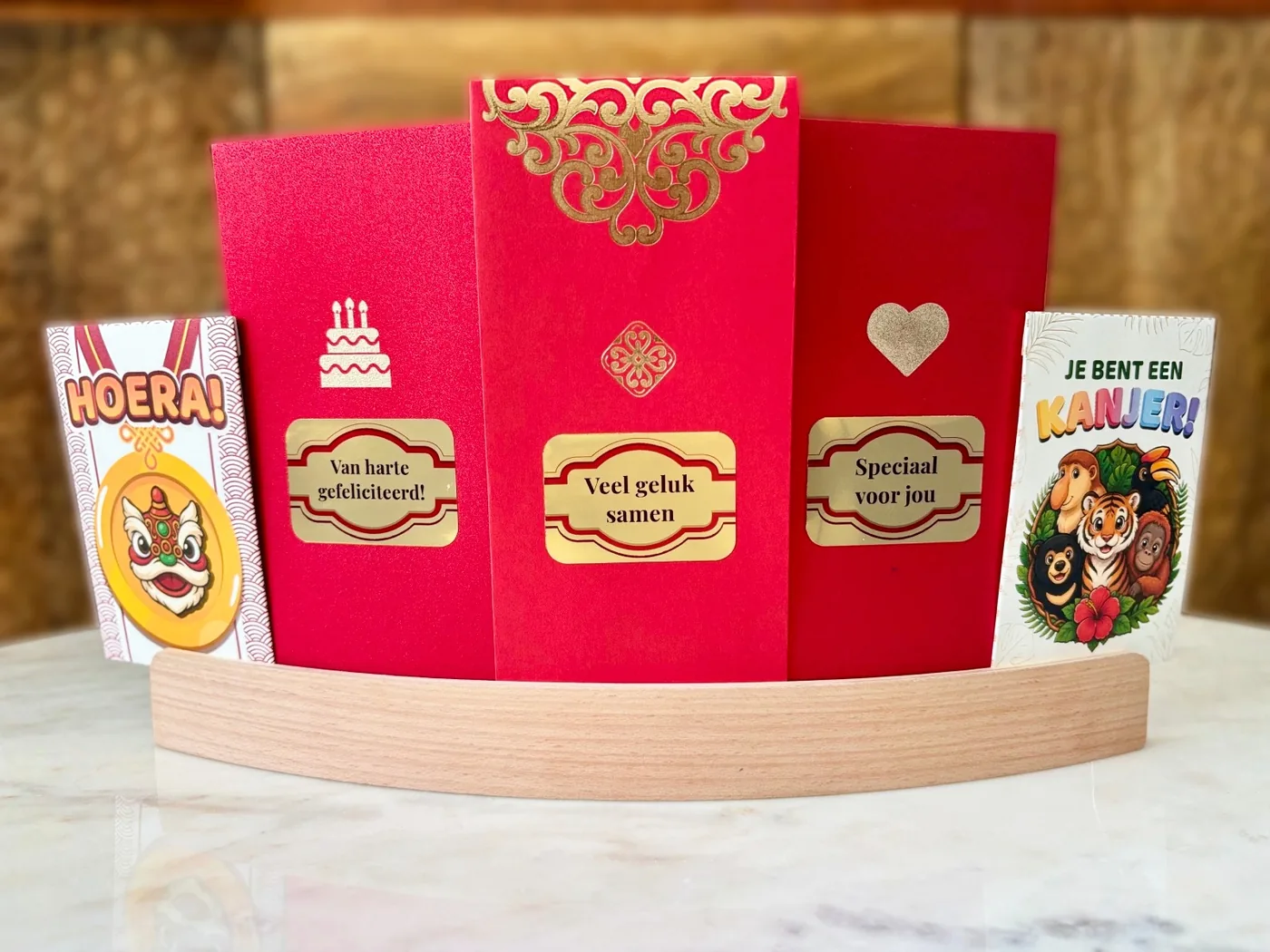
So I began redesigning the angpao. I kept everything that matters: the vibrant red, the gold, the symbolism, the blessing, and the idea that money can be a thoughtful gift — one that gives someone the freedom to choose what matters most to them.
Then I changed what needed to change. Dutch words for Dutch moments. Van harte gefeliciteerd. Trots op jou. Welkom. The tradition stays the same; now the message can be understood by the person receiving it.
This summer, I created my first collection to share at Dordrecht Wereldstad — a festival that celebrates the many cultures that make our city so special. It felt like the perfect place to introduce a tradition that has been part of my life for as long as I can remember.
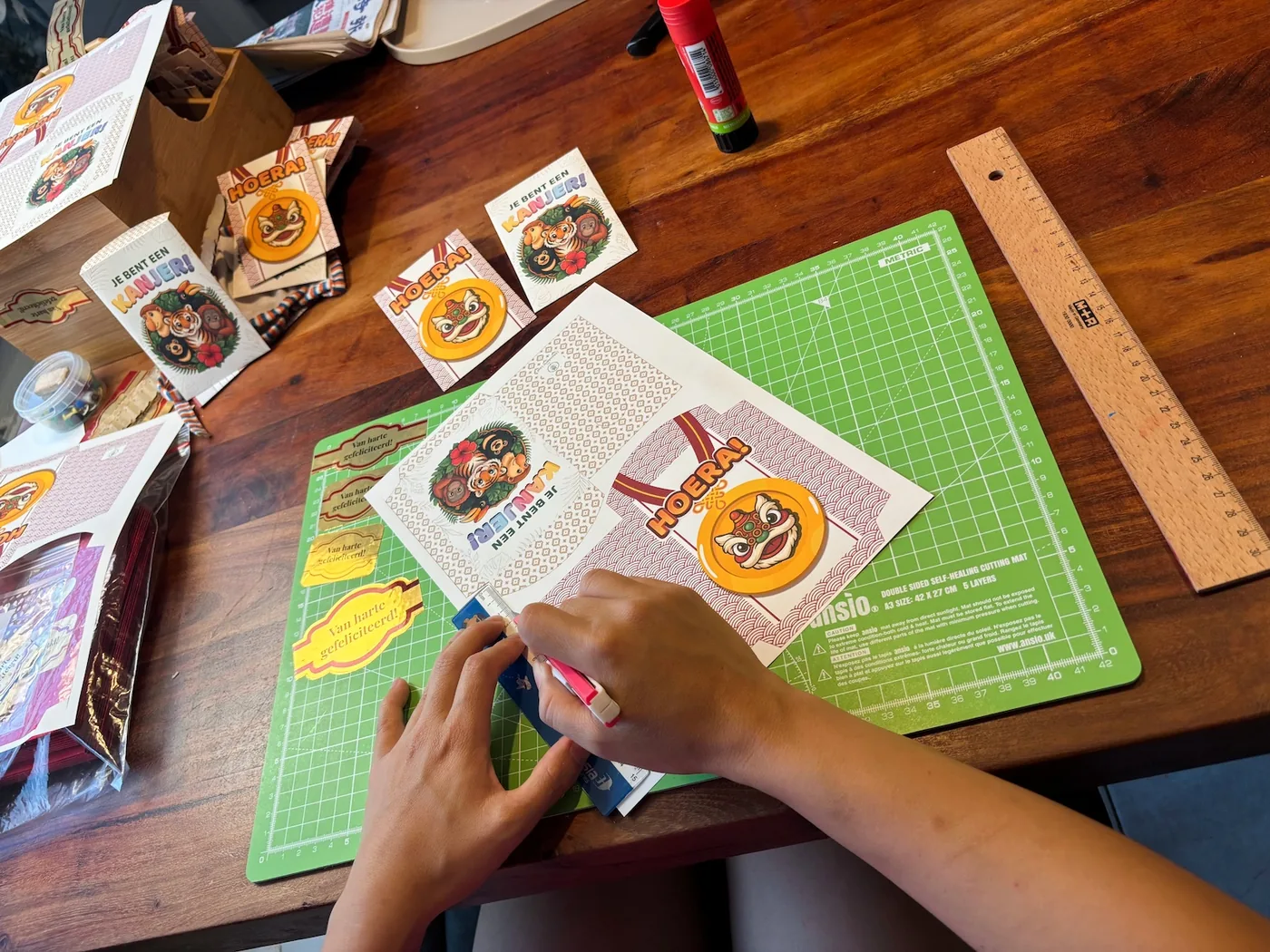
Every envelope is made by hand, at my own table, and that matters to me as much as the design. In a world where so many things are made quickly and thrown away just as fast, I enjoy slowing down. Cutting, folding and finishing each envelope by hand feels like its own small act of care — every fold deliberate, every detail considered. The making is part of the gift.
I’m making these for my own children, so they’ll grow up knowing this gesture the way I did. But I’m also making them for anyone who would like to give a little more than money.
A blessing.
A story.
A tradition.
Because perhaps the most beautiful traditions aren’t the ones we keep to ourselves. They’re the ones we lovingly pass on.
If one of these envelopes finds its way into your hands, I hope it carries all of that — and perhaps the beginning of a tradition in your own family.
An envelope you don’t tear open.
—
Caroline Yip
Founder, The Mandarin Leaf · 葉之心